Welcome. I have been looking forward to this.
You are about to spend three days building the skills that quietly decide who clients trust on an engagement. Not the loudest person in the room. The clearest one. The one who can use a powerful tool with judgment, say the hard thing with grace, and leave a paper trail that protects the whole team.
Here is the truth that runs through everything this week: AI amplifies who you already are. It does not replace your thinking, your voice, or your name on the work. It makes a prepared professional faster and a careful one sharper. My job these three days is to make sure you are that professional before you ever walk onto a client site.
This workbook is yours. Write in it honestly, even when the honest answer is "I am not sure yet." That is where the growth lives. Nobody is grading your first draft. We are building toward Day One together.
Let's get to work.Joi Worthy Johnson | The Joi Method
AI 101
AI literacy is not simply the ability to enter a prompt. It is the ability to determine when AI should be used, how to provide effective direction, how to evaluate the output and how to protect clients, organizations and people from unnecessary risk.
Fictional training scenario. Every exercise in this workbook builds on one case: the SunCoast Energy Data Conversion Project. Open the case file any time; your answers stay exactly where you left them.
Welcome to the Cohort
Before we explore AI, communication, documentation and Agile delivery, we must first establish how we will work together. This is a practice environment with real professional standards. Every participant is expected to contribute, ask questions, provide constructive feedback, protect confidentiality and support the growth of the cohort.
The Assignment in the Room
You will interview one member of the cohort and introduce that person to the group. Listen for more than their job title or professional history. Identify what they bring to a team, how they want to grow and what will help them perform at their best.
Our Cohort Agreement
For all six participants to learn, practice and perform at their best, everyone must help protect the learning environment.
These six statements are editable. Adjust the language as a cohort until every person can stand behind it.
Set Your Intention
Before we begin, name what you want. Growth follows attention, and this is where you point yours.
How prepared do you currently feel to contribute in a client-facing consulting environment? This score is saved and compared with your Day 3 post-assessment.
What Is AI? AI in Your Own Words
You understand a thing when you can explain it plainly. After the demo, write each term the way you would say it to a colleague, not the textbook way.
The Enterprise AI Landscape
As Accenture consultants, you may encounter different AI platforms depending on your role, project, client, geography, license and security requirements.
Embedded across Word, Excel, PowerPoint, Outlook and Teams.
Conversational assistant inside the Microsoft environment.
Enterprise-governed general assistant.
Development and code assistance.
Model services built into secured cloud solutions.
Delivery acceleration platform.
Enterprise AI solution development.
Whatever the client has approved on their own environment.
The tool may change. The responsibility does not.
This training builds the transferable skills underneath the tools.
Participants may later receive more hands-on training for the specific AI platform used on their engagement. The next three days are focused on AI literacy, professional judgment, responsible use and practical consulting application, not product certification.
My Current AI Environment
Before we talk about what AI can do, let's be precise about what you actually have access to and what you have already tried.
AI in the Consulting Workflow
Seven places AI shows up in consulting work. We will practice all seven in the DTI AI Toolkit after we build the prompting method.
- Emails · Documentation · Presentations · Images
- Research · Testing support · Data analysis
The DTI Prompt Method
A lazy prompt gets lazy output. Three letters, and you will never stare at a blank prompt box again.
Fill each field, then build your complete prompt at the bottom and copy it straight into your approved AI tool.
Oracle Conversion Consultant Prompt Library
These prompts are designed to help new Oracle conversion consultants use approved AI tools to support requirements, mapping, data quality, testing, documentation, communication, risk management, and professional development.
My Saved Prompts
Every prompt you save from the library lands here with its own reflection fields. Your notes save automatically on this device.
Choose, Customize, and Test a Prompt
- Select one prompt connected to your current or future Oracle conversion responsibilities.
- Replace all bracketed text with fictional, synthetic, sanitized, or approved information.
- Review the Role, Task, Context, Audience, Format, Tone, Constraints, Source Material, What AI Must Not Invent, Review Method, and Desired Output.
- Copy the completed prompt into your approved AI tool.
- Review the AI response.
- Record what worked and what required human correction.
Prompt Practice Lab: Round 1
Use the DTI Prompt Method on each task. Capture the prompt you used and the one refinement that improved it. The reps matter more than the results.
The DTI AI Toolkit
Open each card as we work it. Every exercise is fictional. Do not use real client names, confidential data or proprietary information anywhere in this workbook.
1Emails
This activity uses the fictional SunCoast Energy Consulting Case File.
Follow-up emails, escalation emails, executive updates, requests for action and clarifying questions.
Accuracy of every fact and date, the tone toward the recipient, the commitment being made on behalf of the team, and confidentiality of anything pasted in.
2Documentation
This activity uses the fictional SunCoast Energy Consulting Case File.
Meeting notes, decision logs, action trackers, status reports, process documentation and requirements summaries.
Whether a decision was actually made, who truly owns each action, dates that are real, and never letting a summary invent an agreement.
| Item | Decision or action | Owner | Deadline | Status | Open question | Source or evidence |
|---|---|---|---|---|---|---|
3Presentations
This activity uses the fictional SunCoast Energy Consulting Case File.
Storyline development, executive summaries, decision-based slide titles, recommendations and speaker preparation.
Every number on every slide, the defensibility of each recommendation, and the fact that structure may come from AI but substance is owned by you.
4Images
This activity uses the fictional SunCoast Energy Consulting Case File.
Concept illustrations, generic process visuals, brainstorming visual directions and presentation support.
Copyright, brand use, bias, real-person likeness, fabricated evidence, client representation and confidentiality. An image that misrepresents reality is a professional risk, not a design choice.
5Research
This activity uses the fictional SunCoast Energy Consulting Case File.
- Discover — cast the net and frame the question
- Verify — prove every claim against a primary source
- Document — show your sources and their dates
Framing the question, generating search directions, summarizing material you already have and challenging your own conclusion.
Independently confirming every source, every citation, every statistic and every date before it reaches a client.
6Testing Support
This activity uses the fictional SunCoast Energy Consulting Case File.
Test-case development, acceptance criteria, edge cases, requirement ambiguity and defect documentation.
Confirming the requirement is real, surfacing ambiguity to the right person rather than assuming, and never letting a generated test case stand in for a validated one.
7Data Analysis
This activity uses the fictional SunCoast Energy Consulting Case File.
Trend identification, outlier review, formula support, questions for further investigation and naming the limitations of the data.
Validating the data, the methodology and the conclusion before anyone acts on it.
PAUSE Before You Prompt
Five seconds of thought before you press enter is the whole difference between a helpful tool and an incident report. PAUSE is the primary AI safety framework for this program.
PAUSE Before You Prompt
Run this every single time. It becomes muscle memory faster than you think.
Use this before any prompt that touches client work. Clear it and reuse it as often as you need.
A short reflection after PAUSE, before the work leaves your hands.
The Compliance Crossroads
This activity uses the fictional SunCoast Energy Consulting Case File.
In a regulated utility environment, what goes into a tool matters as much as what comes out. For each scenario, choose your path and defend it.
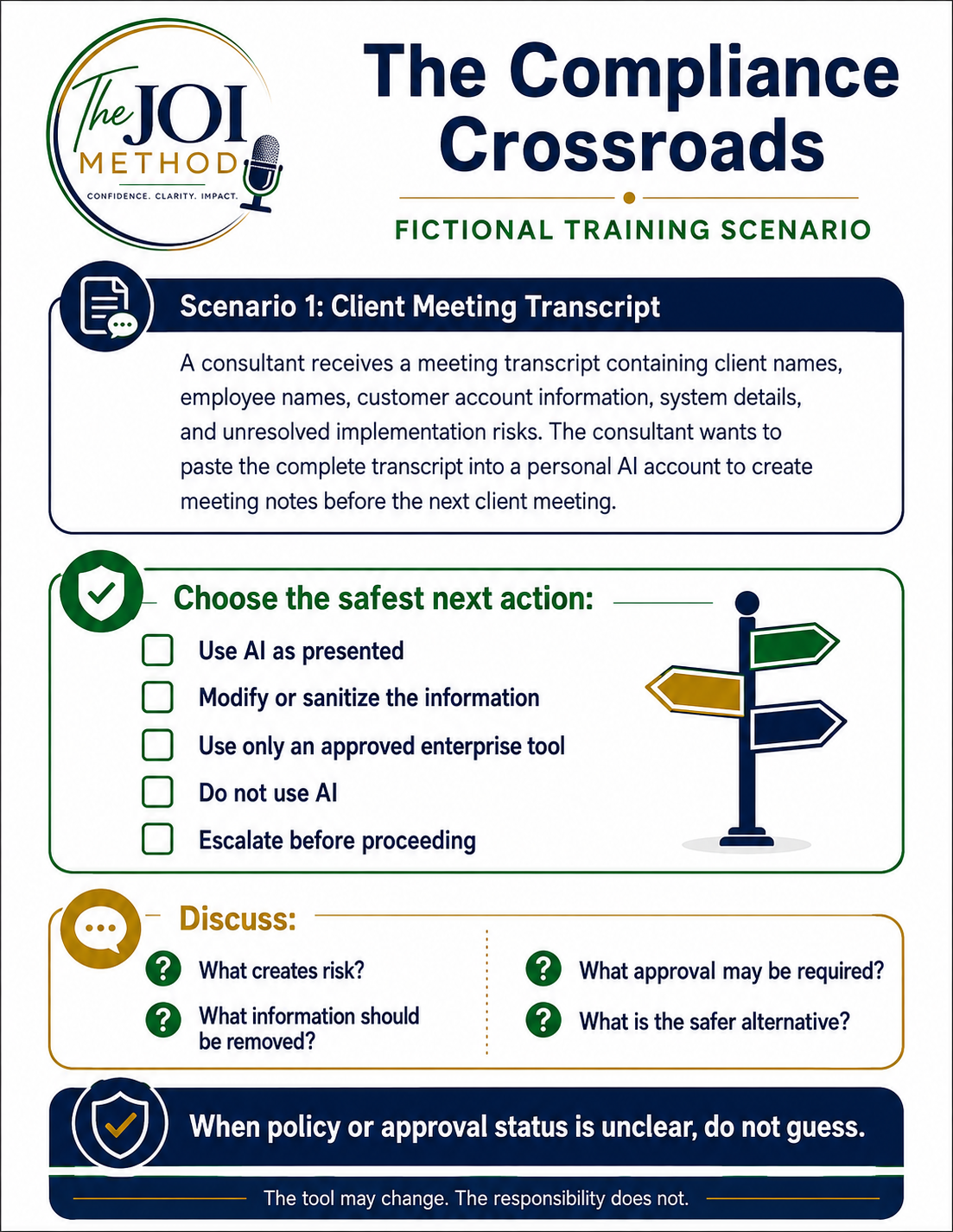
1Scenario 1: Client meeting transcript
A consultant receives a meeting transcript containing client names, employee names, system details, customer information and unresolved implementation issues. The consultant wants to paste the complete transcript into an AI platform to create meeting notes before the next client meeting.
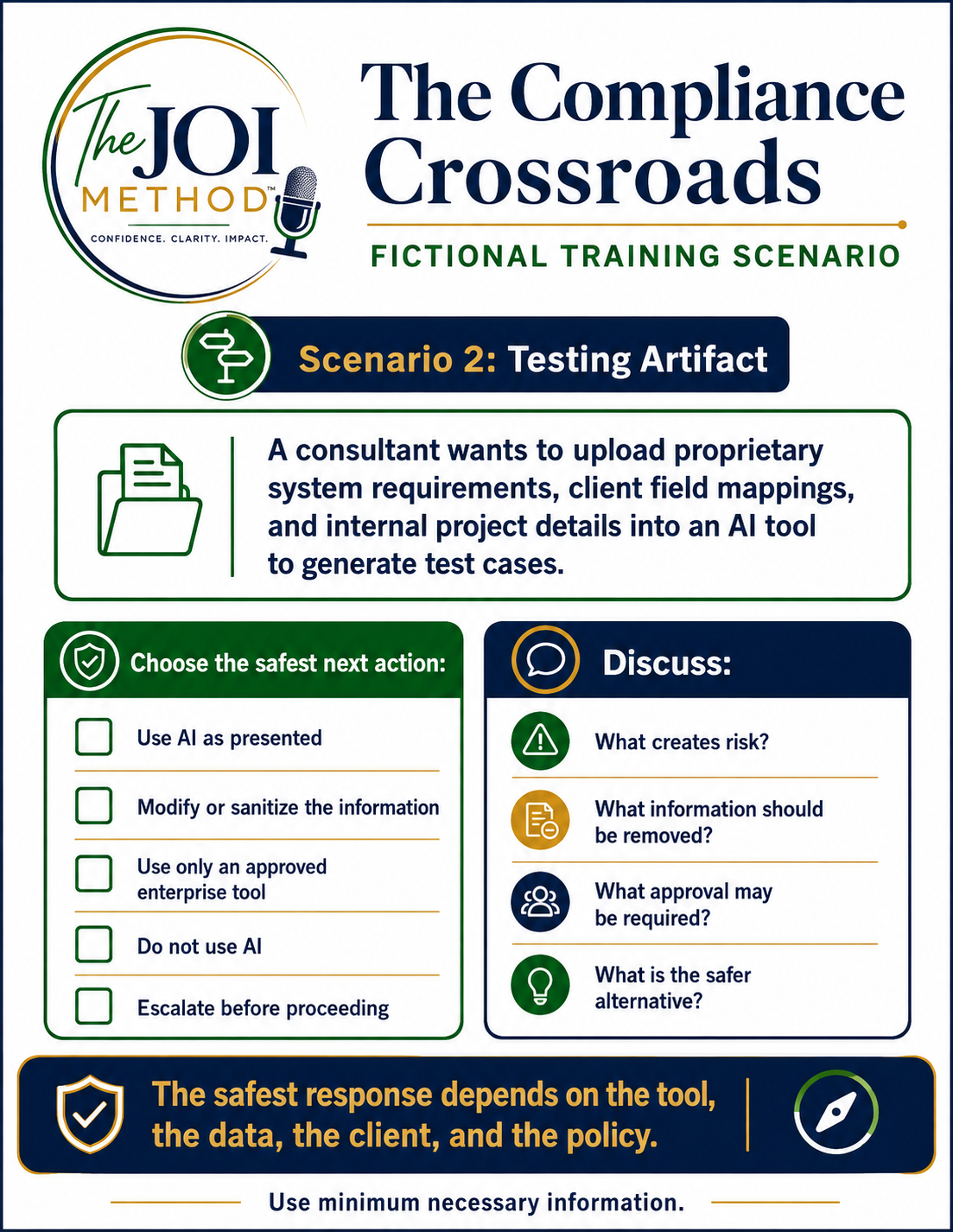
2Scenario 2: Testing artifact
A consultant wants AI to generate test cases using a document that contains proprietary system requirements, client data fields and internal project details.
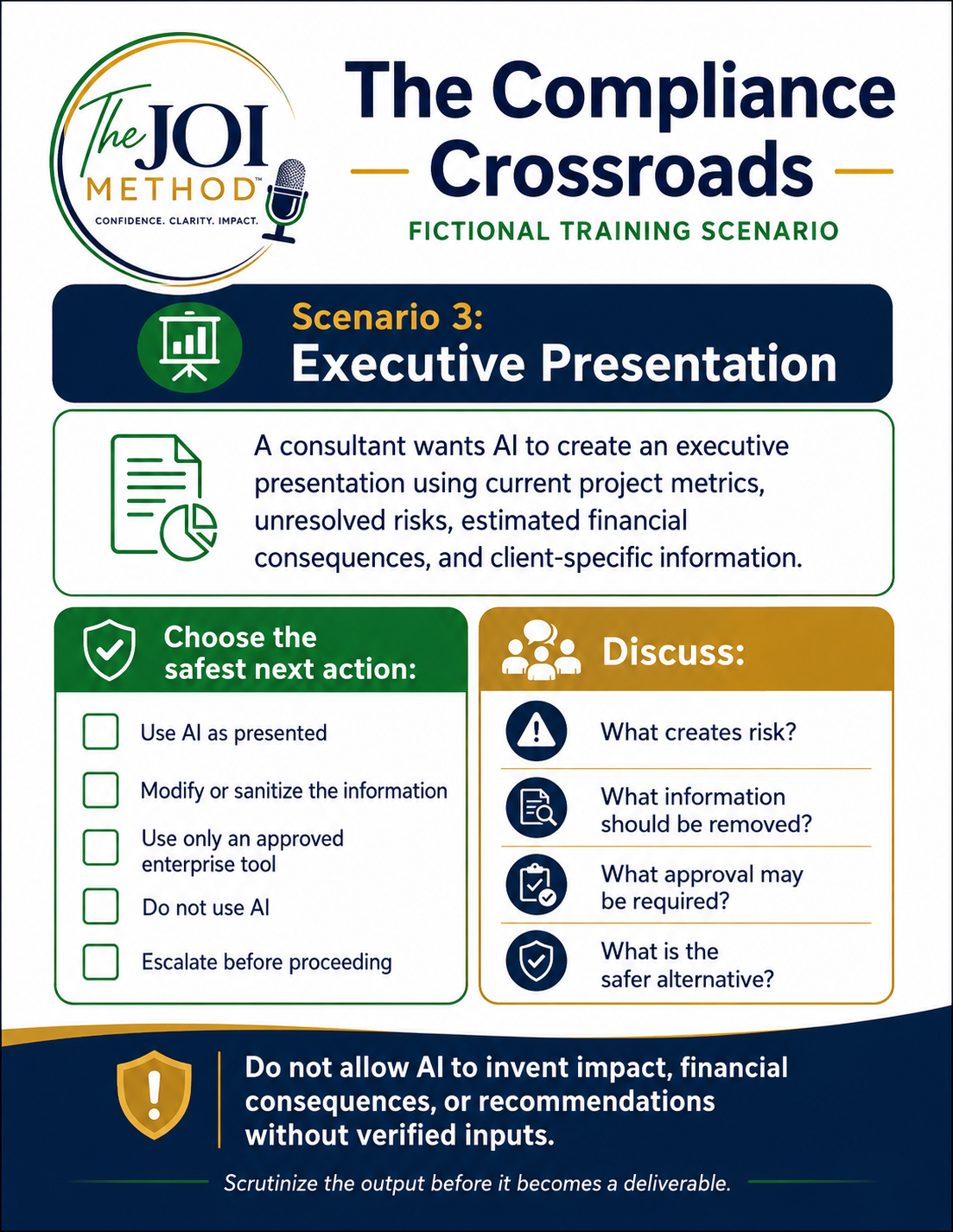
3Scenario 3: Executive presentation
A consultant wants AI to produce an executive presentation containing current project metrics, unresolved risks, financial consequences and client-specific information.
Scenario 1 · Client meeting transcript
Typical strong answer: Modify or sanitize, and use only an approved enterprise tool. Escalate if the transcript covers a regulated or contested issue.
Risk: Named individuals, customer information, system identifiers and unresolved issues create confidentiality, privacy and discoverability exposure. Unresolved issues summarized by AI can also freeze a premature narrative.
Remove: Client and employee names, customer records, org identifiers, system names and version details, account numbers, anything tying the text to a specific client.
Approval: Client contract AI clause, engagement lead sign-off, and confirmation the tool retains no training data.
Safer alternative: Summarize a de-identified extract inside the approved enterprise tool, or draft the summary manually and use AI only to tighten the language.
Coaching point: Listen for participants who justify convenience over permission. The transcript is the client's record, not the consultant's.
Scenario 2 · Testing artifact
Typical strong answer: Use only an approved enterprise tool with sanitized inputs.
Risk: Proprietary requirements, client data fields and internal project details are intellectual property. Pasting them into a consumer tool may breach the agreement and expose the client's data model.
Remove: Real field names, table and schema names, sample records, client-specific business rules and any vendor configuration details.
Approval: Client data-handling terms, QA lead and security review of the tool.
Safer alternative: Generalize the requirement into a neutral pattern ("a customer record with an effective date"), generate test cases, then map them back to real fields offline.
Coaching point: Test cases are a great AI use case — the risk lives entirely in the input, not the output.
Scenario 3 · Executive presentation
Typical strong answer: Escalate before proceeding, then use an approved enterprise tool with sanitized inputs.
Risk: Current metrics, unresolved risks and financial consequences are the most sensitive category on any engagement. Fabricated or overstated figures in a client deck create contractual and reputational exposure.
Remove: Actual financial figures, client name and branding, live risk register entries, anything not yet validated by the project lead.
Approval: Engagement partner or project lead, and client communications protocol for financial impact statements.
Safer alternative: Use AI for structure and slide titles only. Insert the numbers yourself after they are validated. Never let a model generate a figure that will be read as fact.
Coaching point: The strongest answers separate structure (safe for AI) from substance (owned by the human). Remind the room that the participant view intentionally has no single correct answer, because policy differs by company and client.
Three-Minute Client Briefing
This activity uses the fictional SunCoast Energy Consulting Case File.
AI builds the scaffolding. You carry the moment. This is the whole thesis of Day 1 in one exercise.
Is This Client Ready?
The first AI response is not the final deliverable. Use this rubric to evaluate whether an AI-assisted email, document, presentation, analysis, recommendation, or briefing is accurate, appropriate, and ready for professional use.
- Exchange the deliverable with a partner.
- Use the printed rubric for detailed scoring guidance.
- Record your scores and revision notes here.
- Revise the deliverable.
- Make a final Send, Revise, Escalate, or Do Not Use decision.
Are the facts, dates, names, numbers, calculations, sources, and claims correct and verified?
Does the deliverable directly address the assignment, audience need, and required decision or action?
Is the main point easy to understand, logically organized, and concise?
Are all required facts, actions, owners, deadlines, questions, and limitations included or clearly marked “To Be Confirmed”?
Is the level of detail, format, tone, and emphasis appropriate for the intended audience?
Is the tool approved, is the use case permitted, and is the information appropriate to enter and share?
Are claims supported by credible, current, and independently verified sources?
Are confirmed facts, assumptions, unknowns, and missing information clearly separated?
Is the language calm, direct, respectful, and appropriate for the situation?
Has the participant challenged, revised, verified, and professionally taken ownership of the final work?
- Is this information appropriate to share?
- Would DTI, Accenture, and the client approve of this use?
- Can I professionally stand behind every part of the final output?
A one-deliverable record of your scores, stop signs, revision plan, decision, and reflection. It is also included in your Day One Readiness Portfolio.
Personal AI Use Agreement
This is not a worksheet. It is a professional artifact that travels with you onto your first engagement. Write it like you mean it, because you will live by it.
Keep this. On your first engagement, it is your field reference and your standard.
Day 1 Debrief
Carry It Into Day 2
From Findings to Trust
Welcome to Day 2
Yesterday, you used AI, reviewed project information, and created deliverables for the SunCoast Energy Oracle Data Conversion Project.
Today, the question changes. The question is no longer only: Can I create the work? The question is: Can my team and the client trust the work I created?
As an Oracle Conversion Consultant, your work may influence testing, validation, project status, business decisions, client confidence, and the work of other people.
Today, you will practice how to communicate accurately, document responsibly, raise concerns professionally, receive feedback, and contribute with confidence.
- Review work for client readiness
- Separate facts from assumptions
- Distinguish risks, issues, blockers, decisions, and open questions
- Adapt a conversion update for different stakeholders
- Write clear internal and client-facing emails
- Create accurate meeting documentation
- Report project status without minimizing or exaggerating concerns
- Ask focused clarification questions
- Know when to act, ask, or escalate
- Respond professionally when challenged
- Identify when work requires lead review
Describe an observable action, not a general goal such as “be professional” or “do my best.”
Section 14: Is This Client Ready?
AI-assisted work is still your work.
Before an email, status update, analysis, meeting summary, presentation, recommendation, decision log, or action tracker moves forward, someone must confirm that it is accurate, appropriate, supported, and defensible.
As a new consultant, you may not always have authority to send work directly to the client. However, you are still responsible for submitting work that is ready for the appropriate review process.
Client ready means the work is accurate, responsible, traceable, and ready for professional review.
- Reconstruct the original assignment
- Identify the audience and purpose
- Compare the deliverable with the source material
- Identify unsupported statements
- Score the work
- Identify mandatory stop signs
- Revise the most important content
- Challenge and defend the revised work
- Make a final decision
When working in pairs, one person serves as Source Verifier. The second person combines the Client Advocate and Risk and Accountability Reviewer roles.
Reconstruct the Assignment
Before you judge the work, rebuild what the work was supposed to do.
The Ten-Second Test
- What happened?
- Why does it matter?
- What is confirmed?
- What remains unknown?
- What happens next?
- Who needs to act?
Evidence Hunt
- Where did this information come from?
- Is the wording stronger than the evidence?
- Is a possibility being presented as a fact?
- Is an opinion being presented as the team’s conclusion?
- Is a discussion being presented as a decision?
- Was an owner assumed?
- Was a deadline invented?
- Was a client commitment created without approval?
| Statement or Claim | Classification | Source Evidence | Action |
|---|---|---|---|
Every claim needs a source. If you cannot point to the SunCoast case material, classify it as Requires Verification.
Client-Ready Rubric
Facts, dates, names, figures, project status, and claims are correct and verified.
The content directly addresses the assignment and audience need.
The main point is easy to understand and logically organized.
Necessary facts, actions, limitations, owners, and deadlines are included where confirmed.
The tone, terminology, detail, and format fit the intended audience.
The reader understands what must happen next.
The content does not create unsupported commitments or misleading conclusions.
Major claims are supported by the SunCoast case information or validated project records.
The language is calm, direct, respectful, and free from blame or defensiveness.
The participant can explain, support, and defend the final work.
Mandatory Stop Signs
Revision Sprint
What prevents the deliverable from moving forward?
What reduces clarity, accuracy, or usefulness?
What would improve presentation without changing the meaning?
| Original Content | Revised Content | Why the Change Matters |
|---|---|---|
Challenge and Defend
Final Client-Ready Decision
From Student to Consultant
A consulting team does not build trust based only on intelligence or technical skill.
Trust is built through preparation, accuracy, follow-through, communication, professional judgment, and a willingness to learn.
Corporate confidence is being prepared, honest, responsive, and accountable.
The Trust Account
What makes a lead trust you with greater responsibility?
What causes a lead to lose confidence in your work?
Read the Situation Before You Communicate
Consultants are trusted when they name things accurately. These eight words are not interchangeable.
SunCoast Classification Lab
| Statement | Classification | Evidence | What Should Happen Next |
|---|---|---|---|
| Validation Cycle 1 was completed Friday. | |||
| Inconsistent date formats appear in multiple source files. | |||
| Jordan believes the inconsistent date formats are causing failed records. | |||
| Alicia believes existing transformation rules may resolve some records. | |||
| The August 7 validation milestone will be delayed. | |||
| No one confirmed ownership of the duplicate-account analysis. | |||
| Account classifications were validated. | |||
| Tanya’s question about account classification was not documented. | |||
| Missing communication preferences may affect customer notices. | |||
| The business team may need to be involved. | |||
| Robert requested an update before tomorrow afternoon. | |||
| The next review meeting will be Wednesday. | |||
| The next review may be Wednesday, but the time is not confirmed. |
Ask, Act, or Escalate
| Scenario | Act / Ask / Escalate | Who Should Be Involved? | Next Responsible Action |
|---|---|---|---|
| A source file is missing a required column. | |||
| A client stakeholder has not answered a mapping question. | |||
| Source and target record totals do not reconcile. | |||
| You do not know which assignment is the priority. | |||
| A client asks you to guarantee August 7. | |||
| Duplicate-account analysis has no confirmed owner. | |||
| Confidential data appears in an unapproved AI tool. | |||
| Meeting notes list a proposed decision as approved. | |||
| A teammate misses an internal deadline. | |||
| Missing customer communication preferences may affect required notices. |
Communicate the Conversion Story
- What was completed?
- What was found?
- What is confirmed?
- What remains unknown?
- What happens next?
- What is needed?
- Validation Cycle 1 is complete.
- The team found inconsistent date formats across multiple source files.
- Existing transformation rules may resolve some affected records.
- The full failed-record impact has not been confirmed.
- Ownership of the duplicate-account analysis has not been confirmed.
- The August 7 validation milestone has not officially changed.
- The client has not yet been informed of possible schedule exposure.
Four Stakeholders, Four Messages
The facts do not change. The detail, framing, and request change with the audience.
Prepare a 30-second update for a peer who may help investigate the issue.
Prepare a 60-second internal update. The lead must determine whether the matter should be discussed with the client.
Prepare a concise client-facing update and one focused question.
Prepare a 30-second executive update.
Partner Feedback and Redo
Write Like a Consultant
- Why I am writing
- What has been confirmed
- What needs attention
- What is happening next
- What I need from the recipient
Internal Accenture Email
I just wanted to reach out and let you know that we have been looking at some of the files and there seem to be a lot of issues with the dates. We think this is probably why the records failed and it might delay the next cycle. Alicia thinks the transformations could work, but we do not really know yet. The client has not been told. Please let me know what you think when you get a chance because we probably need to do something soon.
Thanks.
Client Follow-Up Email
Thank you for agreeing to provide the approved formats by tomorrow morning. Once we receive those, our team will fix the transformation rules and keep the August 7 cycle on schedule.
Please send the information as soon as possible.
Email Peer Review
Status Without Spin
SunCoast Status Challenge
- Validation Cycle 1 completed
- Date-format inconsistencies found in multiple files
- Some transformation rules may resolve affected records
- Full failed-record impact remains under review
- Duplicate-account analysis has no confirmed owner
- Account-classification validation is not documented
- Missing communication preferences may affect customer notices
- August 7 has not officially changed
- Robert requested an update before tomorrow afternoon
Defend the Status
Document What Actually Happened
It is an accurate record of what the team needs to know, do, decide, or monitor.
- A suggestion into a decision
- A discussion into approval
- A possibility into a fact
- “Someone” into an owner
- “Maybe” into a deadline
Raw SunCoast Meeting Notes
- Validation Cycle 1 completed Friday.
- The date-format issue appears in multiple source files.
- Jordan believes the inconsistent date formats are causing failed records, but Alicia says the existing transformation rules may resolve some of them.
- Marcus wants to know whether the August 7 validation date is still realistic.
- No one confirmed who owns the duplicate-account issue.
- Tanya asked last week whether account classifications were validated, but the response was not documented.
- The client has not been informed about a possible schedule impact.
- Robert wants an update before tomorrow afternoon.
- More analysis is needed.
- Someone should determine whether missing communication preferences could affect required customer notices.
- The business team may need to be involved.
- The next review meeting may be Wednesday, but the time has not been confirmed.
Nothing above may be upgraded into a decision, an owner, or a deadline without confirmation.
Meeting Summary
| Update | Source | Confirmed or To Be Confirmed |
|---|---|---|
| Action | Owner | Due Date |
|---|---|---|
| Open Question | Who Can Answer |
|---|---|
Decision Log
| Decision | Decision Maker | Date | Basis | Impact |
|---|---|---|---|---|
Action Tracker
| Action | Owner | Due Date | Status | Dependency |
|---|---|---|---|---|
Risk and Issue Log
| ID | Type | Description | Potential Impact | Owner | Response |
|---|---|---|---|---|---|
Where ownership is not confirmed, write Owner To Be Confirmed rather than assigning a name.
Open-Question Log
| Question | Why It Matters | Who Can Answer | Needed By |
|---|---|---|---|
Use Due Date To Be Confirmed, Business Validation Required, or Decision Pending where nothing is confirmed.
Documentation Audit
Consultant Hot Seat
You will be asked a direct question in front of the team. The goal is not a perfect answer. The goal is a credible one.
- Pause
- Answer the actual question
- State what is confirmed
- Identify what remains unknown
- Explain the next action
- Make a recommendation or request when appropriate
Two-Minute Briefing Prep
Challenging Questions
Hot Seat Feedback
Day 2 Readiness Reflection
Rate yourself as you felt at the beginning of today, then as you feel now. 1 = not yet, 5 = consistently.
| Skill | Beginning of Day | End of Day |
|---|---|---|
| Reviewing work for client readiness | ||
| Separating facts from assumptions | ||
| Asking clarification questions | ||
| Communicating project status | ||
| Writing professional emails | ||
| Documenting decisions and actions | ||
| Raising risks appropriately | ||
| Responding under pressure | ||
| Receiving and applying feedback | ||
| Knowing when to seek lead review |
Personal Reflection
Consulting-Readiness Commitment
I will verify my work, communicate what is known, identify what remains unknown, document commitments accurately, and ask for guidance before making decisions outside my authority.
I understand that the quality of my work affects the trust placed in me, my team, and the client relationship.
Day 2 Portfolio
This is your Day 2 consulting-readiness portfolio. Each line reflects what you have completed in this workbook.
Your responses save automatically in this browser. Download a copy before you close the workbook.
Agile + Applied Learning
Day 3 Open
Agile + Scrum Fundamentals
Agile is a meeting rhythm and a set of expectations, not a certification. Learn the loop, learn what is expected of you in each ceremony, and you can contribute from week one.
- Sprint Planning, the team decides what to tackle this sprint
- Daily Standup, a fast sync: done, doing, blocked
- Sprint Review, show the work, get feedback
- Retrospective, what went well, what to improve
Team Collaboration Expectations
- Contributor: raises blockers early, updates the tracker unasked, asks the clarifying question
- Observer: waits to be assigned, hides struggle, goes quiet in review
Agile Standup Simulation
This activity uses the fictional SunCoast Energy Consulting Case File.
You are a consultant on the SunCoast Energy data conversion engagement. The PM is stressed and moving fast. Draft your standup update from your role card, then deliver it.
Delivery Workflow + Escalation Judgment
This activity uses the fictional SunCoast Energy Consulting Case File.
Knowing what to solve yourself, what to raise to your lead, and what goes to the PM immediately is a core consulting judgment. Map yours.
The Day One Simulation
This activity uses the fictional SunCoast Energy Consulting Case File.
You are a DTI consultant on Day One of a large-scale SunCoast Energy implementation. Five escalating challenges. Stay in character, use everything you built this week, and capture a quick note to yourself after each. Your facilitator is scoring, so give it everything.
Challenge 5: The Executive Walkthrough
This activity uses the fictional SunCoast Energy Consulting Case File.
A five-minute status to a senior executive. This is the moment everything converges. After you deliver, rate yourself on METHOD again and see how far you moved since Tuesday.
Simulation Debrief
My Feedback Session
During your one-on-one, write down what your facilitator names. You will want this on your first day.
Communication Intelligence: Where You Landed
The same eight statements from Day 2. Rate yourself now, at the end of the week, and look at how far you moved. This is your growth, in your own hand.
What I Am Walking In With
The Day One Field Guide
This is yours to keep. When you walk onto your first DTI engagement and the room feels fast, come back here. Everything you practiced is on this page.
- D — Define the task. What must the AI produce or accomplish?
- T — Tell it the context. What background does the AI need?
- I — Identify the requirements. Audience, format, tone, length, limitations, success criteria.
- Supporting ingredients inside the method: Role, Context, Task, Format, Constraints.
- P — Permission. Is this AI tool approved by the organization and the client?
- A — Anonymize. Have names, identifiers and sensitive information been removed?
- U — Use the minimum necessary information.
- S — Scrutinize the output. Facts, calculations, sources, assumptions, bias, omissions.
- E — Escalate when uncertain. Project lead, security, privacy, legal or compliance.
- Is this information appropriate for me to share?
- Would the client approve of this use?
- Can I professionally stand behind the final output?
- Read the Room, sense the audience and the moment
- Craft the Message, shape it for who is listening
- Deliver with Presence, hold the room while you say it
- Manage the Response, steer what happens next
- Memorable Engaging Thought-provoking
- High-powered Original Dynamic
- Subject that carries the ask
- First line that states the point
- Body that respects the scroll
- Close with one clear action and owner
- State it plainly
- Show you understand the impact
- Present the recovery plan
- Make the ask. Never green-wash a yellow.
- What I completed
- What I am working on
- What is blocking me. Fifteen seconds.
- Solve what is yours to solve
- Raise to your lead what you cannot
- Ask for help at 70 percent stuck, not 100 percent
- Never fabricate to fill a gap. Flag it.
Export Your Work
Two ways to take this with you. Save the full workbook, or download the condensed portfolio.
This condensed portfolio includes the professional commitments, feedback, assessments, and field-reference tools you will want after training.